
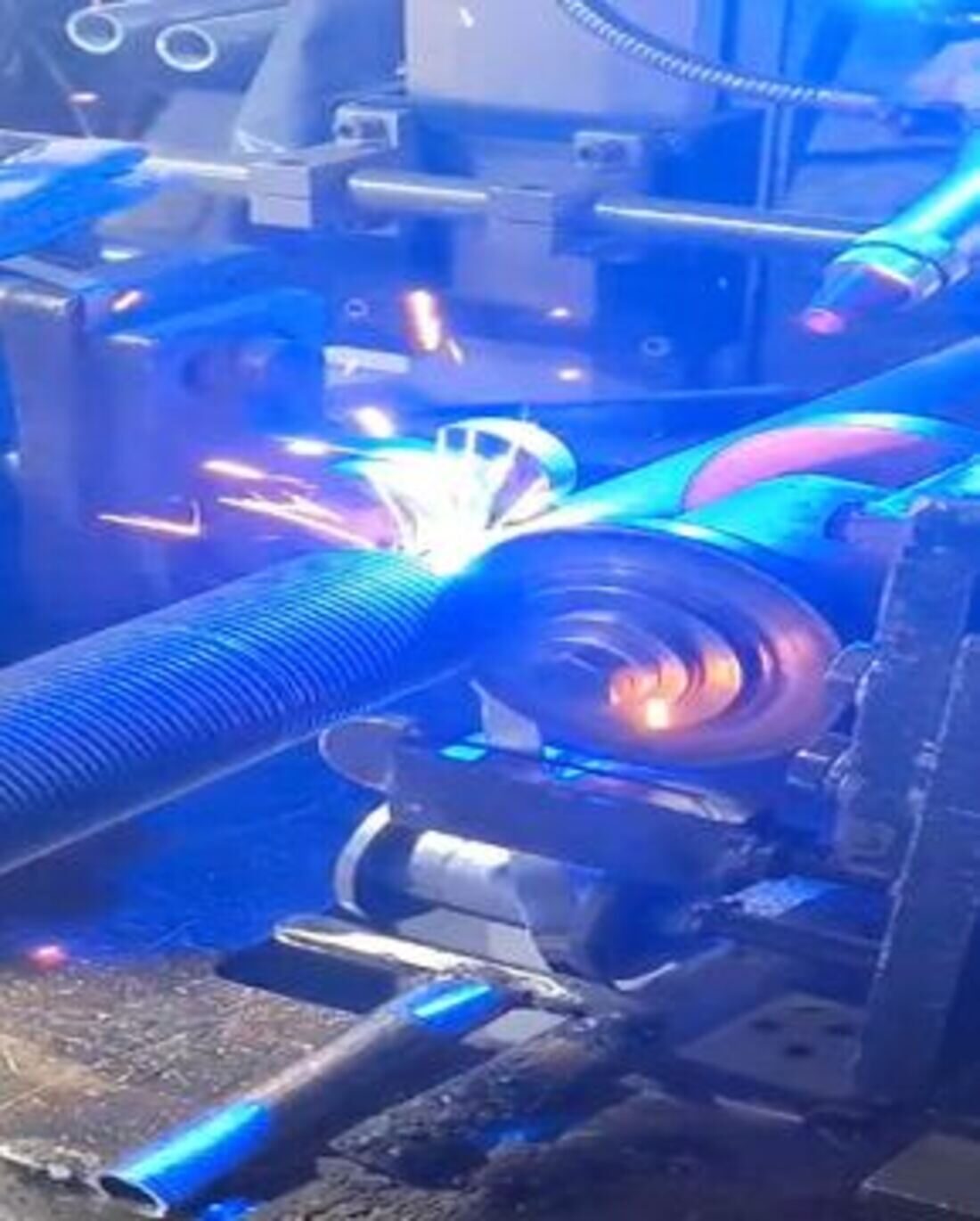
A focused laser welds a thin fin strip to the base tube with minimal heat input — a narrow, clean weld that keeps the tube metallurgy intact and allows thin fins on stainless and alloy tubes.
Why laser welding
Laser welding delivers a precise amount of energy exactly at the fin foot. The heat-affected zone stays narrow, so the base tube does not distort and the corrosion resistance of stainless steel is preserved. Fin thickness down to 0.3 mm can be welded reliably, which is difficult with high-frequency welding.
Product Gallery
Typical specification
| Parameter | Range |
|---|---|
| Base tube OD | 16 mm – 219 mm |
| Base tube material | Stainless steel 304 / 316L / 321, duplex, carbon steel, alloy steel |
| Fin material | Stainless steel, carbon steel, copper, aluminium |
| Fin height | 8 mm – 30 mm |
| Fin pitch | 3 mm – 10 mm |
| Fin thickness | 0.3 mm – 2 mm |
| Working temperature | Up to 700 °C (1292 °F) |
Advantages
- Narrow heat-affected zone — no annealing of the base tube and no loss of corrosion resistance.
- Very low thermal contact resistance thanks to the true metallurgical joint.
- Thin fins possible, which reduces weight and cost for the same surface area.
- Clean weld bead, suitable for hygienic and high-purity duties.
Applications
Stainless steel air coolers, food and pharmaceutical dryers, chemical process gas coolers, marine and offshore exchangers, and any duty where a welded fin is required on a thin-wall stainless tube.
Discuss a laser welded fin tube project
Tell us the tube diameter, fin height, fin pitch, materials and quantity — we reply with price and lead time within one working day.