
Why a fin works, how much surface it really adds, and where the efficiency limit comes from — the physics behind the fin geometries we manufacture.
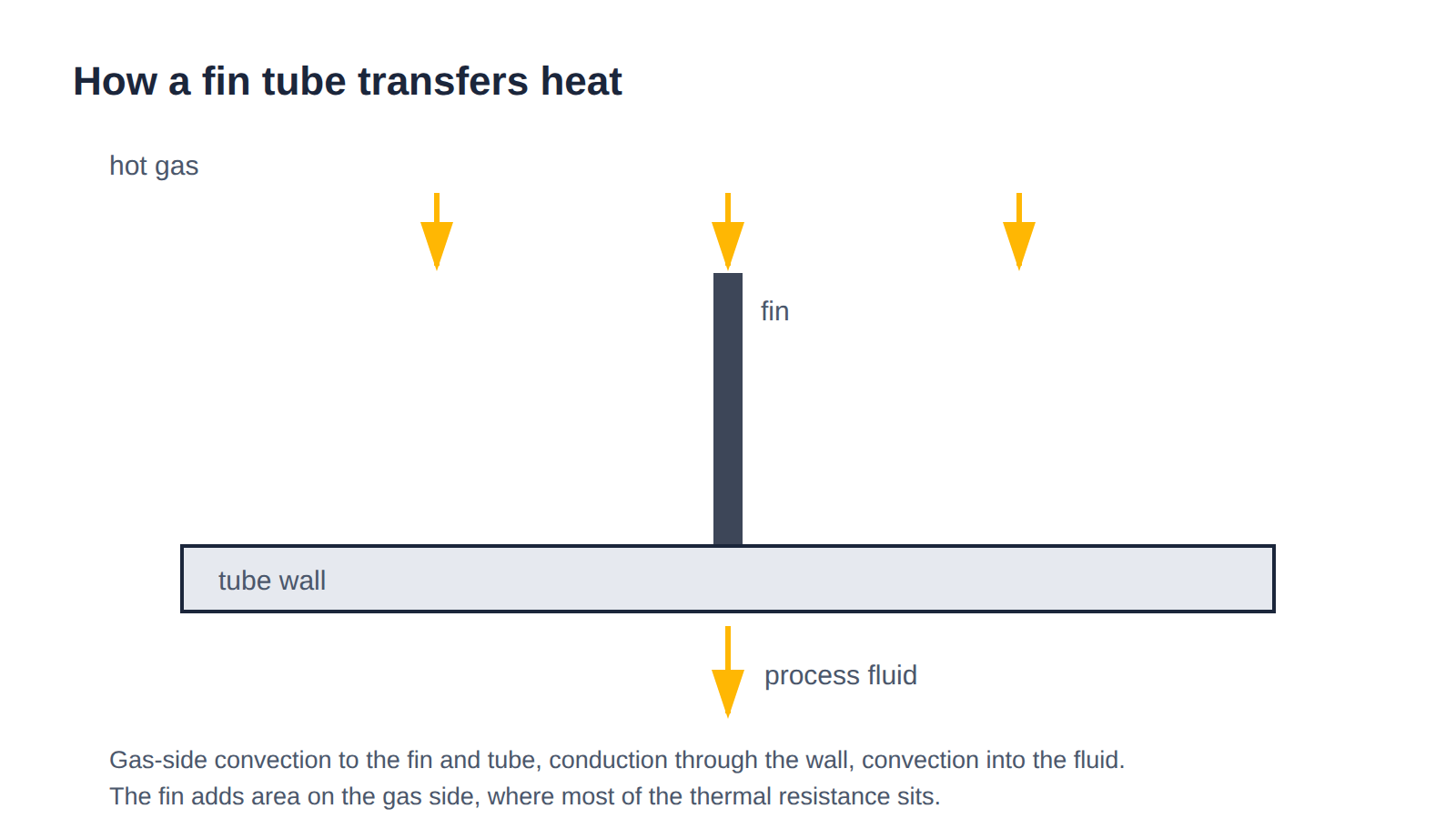
The resistance chain
Heat passing from a hot fluid to air crosses five resistances in series: the tube-side film, the tube wall, the fin-to-tube contact (if any), the fin itself, and the air-side film. In an air cooler the air-side film is typically 80–90 % of the total, which is why adding surface on the air side is so effective.
Fin efficiency
A fin is not isothermal. Its tip runs cooler than its root, and the ratio of actual heat transfer to the ideal (isothermal) value is the fin efficiency. Tall, thin, highly conducting fins are less efficient than short, thick ones. Typical efficiencies:
| Fin height | Aluminium fin, air side | Efficiency |
|---|---|---|
| 6 mm | h = 60 W/m²K | ≈ 0.95 |
| 12 mm | h = 60 W/m²K | ≈ 0.85 |
| 16 mm | h = 60 W/m²K | ≈ 0.76 |
| 25 mm | h = 60 W/m²K | ≈ 0.62 |
This is why a very tall fin does not deliver proportional benefit: beyond about 16 mm the added area is increasingly ineffective unless the fin material conducts well and the air-side coefficient is low.
Surface area multiplication
A 12 mm fin at 3.2 mm pitch on a 25 mm tube multiplies the bare surface area by roughly 8–10 times. The exact figure depends on fin thickness, pitch and height; we calculate it per project and state it on the drawing.
Serrated and interrupted fins
Cutting the fin into segments breaks up the boundary layer and raises the air-side coefficient by 10–20 %. The trade-off is a slightly higher pressure drop and a fin that is more easily damaged during cleaning, so serrated fins are best for clean gas streams.
Ask for a heat transfer calculation
Tell us the tube diameter, fin height, fin pitch, materials and quantity — we reply with price and lead time within one working day.