
Taller fins add surface but lose efficiency at the tip. The right height depends on the air-side coefficient, the fin material and the space available in the bundle.
The efficiency trade-off
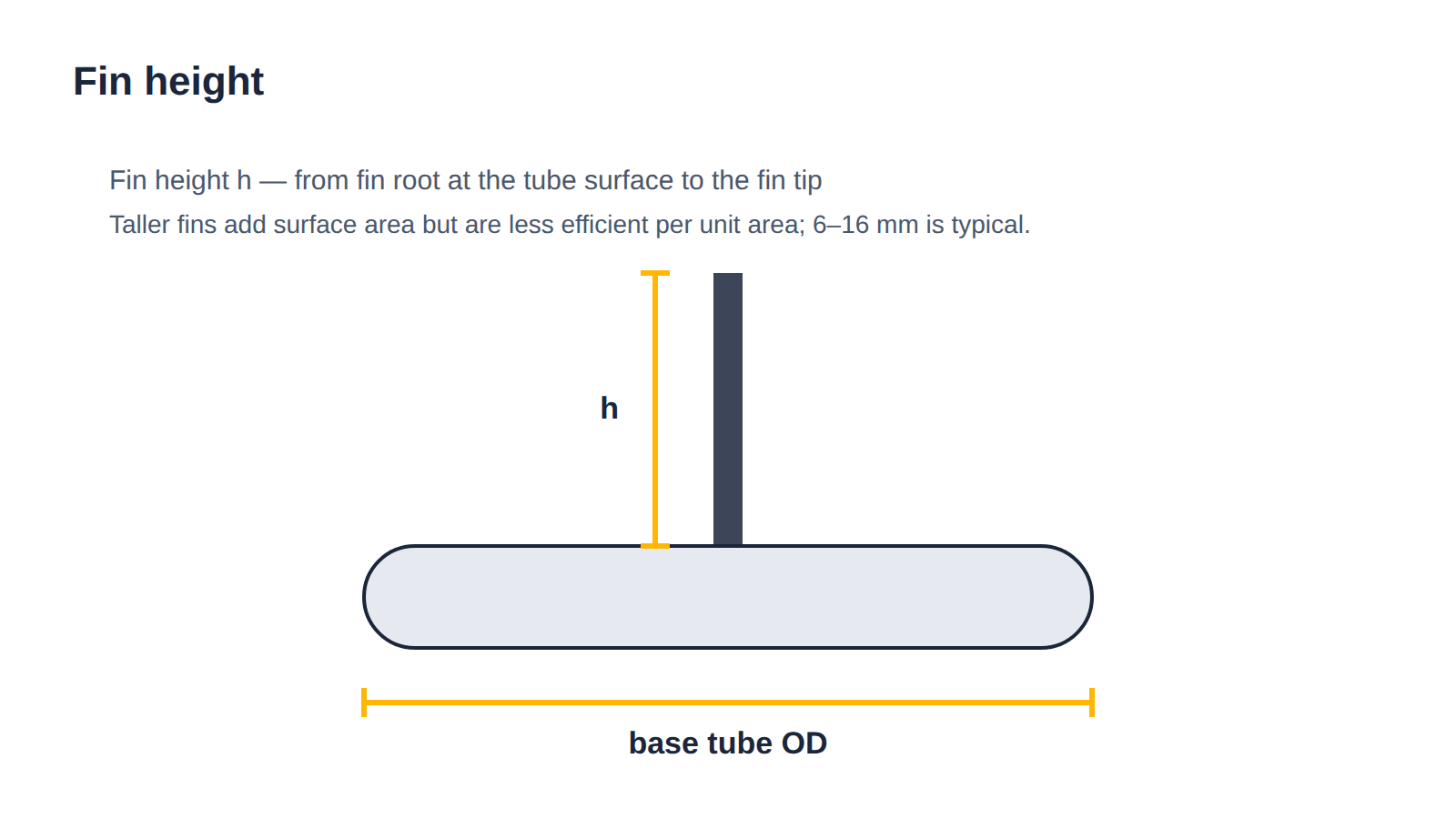
Fin efficiency falls as height increases. With aluminium fins and a typical air-side coefficient of 60 W/m²K, efficiency drops from about 0.95 at 6 mm to about 0.62 at 25 mm. The effective area therefore grows more slowly than the geometric area, and the pressure drop grows with the square of the velocity in the narrowed channel.
Typical heights by fin type
| Fin type | Typical height | Maximum |
|---|---|---|
| Integral (rolled) | 1.5–3 mm | 5 mm |
| L / LL / KL | 6–16 mm | 25 mm |
| Extruded bimetal | 6–12 mm | 16 mm |
| Embedded (G) | 8–16 mm | 16 mm |
| HF welded | 10–25 mm | 38 mm |
| Laser welded | 8–20 mm | 30 mm |
When to go taller
- The air-side coefficient is low (natural convection, low face velocity).
- Bundle depth is limited and you need area in a short length.
- The fin material conducts well (aluminium, copper) so efficiency holds up.
When to stay short
- High face velocity — tall fins raise pressure drop sharply.
- Dusty or corrosive service where cleaning is difficult.
- Space is available for more rows, which is usually more efficient than taller fins.
Ask us to check your fin height
Tell us the tube diameter, fin height, fin pitch, materials and quantity — we reply with price and lead time within one working day.