
A steel strip is welded to the base tube by high-frequency resistance welding, producing a solid metallurgical bond that survives 600 °C and aggressive flue gas — the standard choice for economisers, boilers and waste-heat recovery.
The welding process
A flat strip is fed onto the rotating base tube while a high-frequency current melts the interface. The strip is wound into a helix and welded continuously along its foot. Because the fin foot and the tube surface are fused, the joint is metallurgical rather than mechanical, and there is no filler metal, flux or subsequent heat treatment.
Product Gallery
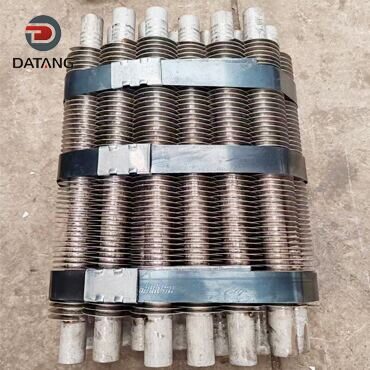
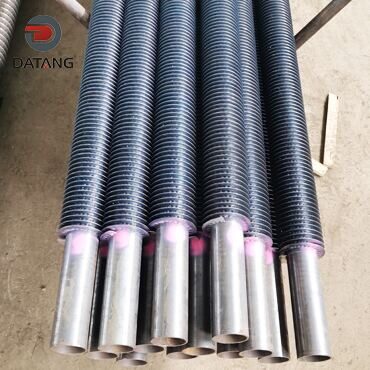
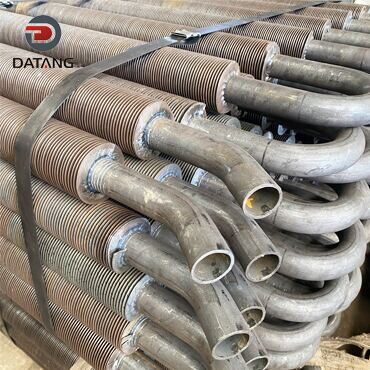
Typical specification
| Parameter | Range |
|---|---|
| Base tube OD | 25 mm – 273 mm |
| Base tube material | Carbon steel, stainless steel, alloy steel (T11, T22, P5, P9), ND steel |
| Fin material | Carbon steel, stainless steel, alloy steel |
| Fin height | 10 mm – 38 mm |
| Fin pitch | 4 mm – 12 mm |
| Fin thickness | 0.8 mm – 3 mm |
| Working temperature | Up to 600 °C (1112 °F), higher with matching alloys |
| Production standard | ASME / ASTM, HG/T, customer drawings |
Advantages
- Metallurgical bond — no contact resistance and no loosening under thermal cycling.
- High temperature capability, suitable for boiler economisers, air preheaters and HRSG modules.
- Resistant to soot-blower erosion and high-ash flue gas when fin thickness is specified correctly.
- Available in long single lengths to reduce field welds.
Design notes
For coal-fired and biomass duties we recommend a minimum fin thickness of 1.0–1.5 mm and a pitch wide enough to avoid ash bridging. Serrated (cut) fins can be added to improve heat transfer in clean gas streams. Tell us the flue gas composition, dust load and metal temperature and we will propose the strip grade and geometry.
Get an HF welded fin tube quotation
Tell us the tube diameter, fin height, fin pitch, materials and quantity — we reply with price and lead time within one working day.