
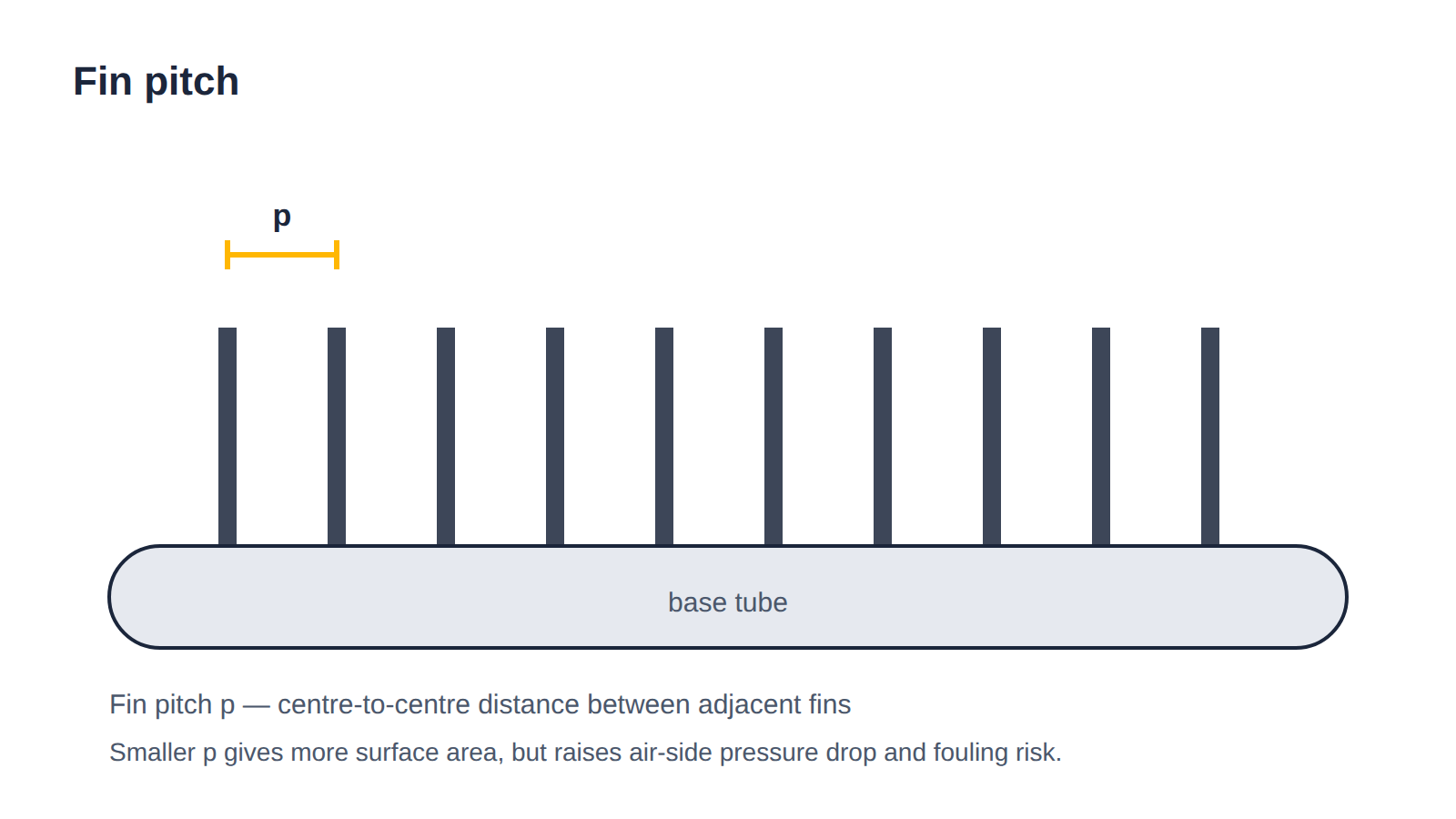
Fin pitch — the distance between adjacent fins — is the single most consequential choice after fin type. It trades surface area against pressure drop and fouling risk.
What pitch does
Reducing the pitch packs more fins into the same length, increasing surface area and heat transfer. It also narrows the gap the air must pass through, raising pressure drop and accelerating fouling. The optimum is the point where the marginal gain in heat transfer no longer justifies the marginal fan power and cleaning cost.
Practical ranges
| Service | Fin pitch | Comment |
|---|---|---|
| Clean air, HVAC, dryers | 2.3–2.8 mm | Maximum area, lowest cost per kW |
| General industrial air cooling | 3.0–3.5 mm | The default for most air coolers |
| Slightly dusty gas | 4.0–5.0 mm | Easier cleaning, slower fouling |
| Coal or biomass flue gas | 6.0–9.0 mm | Soot blower access, ash bridging |
| Heavy dust / cement | 10–12 mm or studded | Cleanability dominates |
Fouling versus efficiency
A dense fin that fouls in six months performs worse over a year than a wider pitch that stays clean. For anything other than clean air, choose the pitch for the cleaning method first and the heat transfer second.
Tolerance matters
Uneven pitch creates local hot spots and increases pressure drop. Our winding and welding lines hold pitch within ±0.1 mm, and every batch is measured at three points along the tube.
Tell us the gas condition and we will recommend a pitch
Tell us the tube diameter, fin height, fin pitch, materials and quantity — we reply with price and lead time within one working day.