
Base tube and fin material selection decides corrosion life, temperature capability and cost. This page lists what we stock and what we can source.
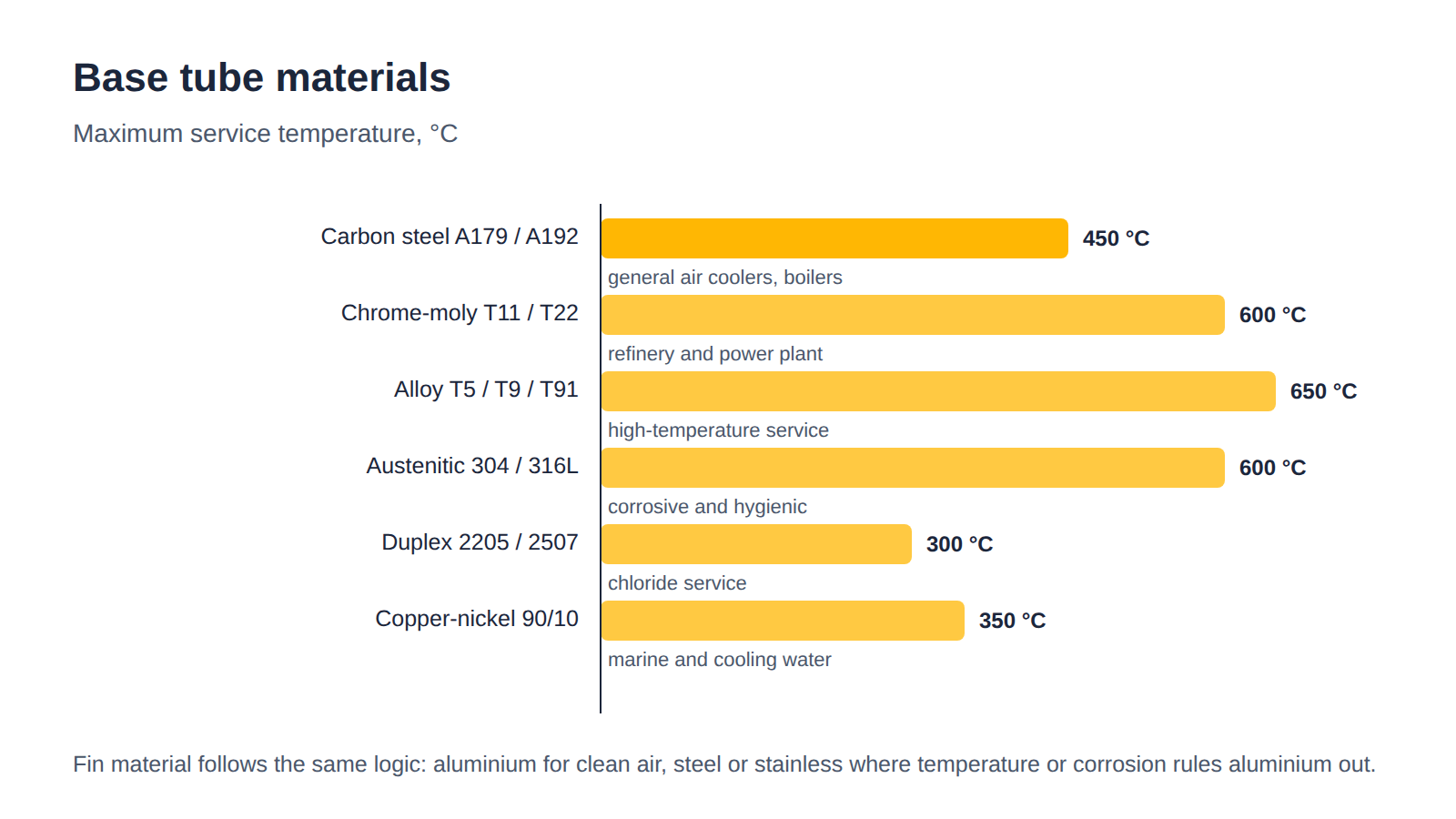
Base tube materials
| Standard | Material | Typical use | Max temp. |
|---|---|---|---|
| ASTM A179 | Seamless carbon steel | General air coolers | 400 °C |
| ASTM A192 | Seamless carbon steel, high pressure | Boiler and high-pressure service | 450 °C |
| ASTM A213 T11 / T22 | Chrome-moly alloy | Refinery and power plant | 550–600 °C |
| ASTM A213 T5 / T9 / T91 | Alloy steel | High-temperature service | 600–650 °C |
| ASTM A312 TP304 / 316L | Austenitic stainless | Corrosive and hygienic | 600 °C |
| ASTM A789 / A790 | Duplex stainless | Chloride service | 300 °C |
| ASTM B111 | Copper-nickel 90/10, 70/30 | Marine and cooling water | 300 °C |
| ASTM B338 | Titanium | Seawater and aggressive chemicals | 300 °C |
Fin materials
| Material | Max temp. | Corrosion behaviour | Cost |
|---|---|---|---|
| Aluminium 1060 / 1100 | 250 °C | Good in clean air; poor in chlorides/alkalis | Low |
| Aluminium 3003 | 250 °C | Better than 1060 in mild atmospheres | Low |
| Copper | 300 °C | Good, but incompatible with ammonia | Medium |
| Carbon steel | 500 °C | Needs coating in wet atmospheres | Low |
| Stainless 304 / 316L | 600 °C | Good general corrosion resistance | High |
| Alloy steel (T11, T22) | 600 °C | High temperature, low corrosion | Medium-high |
Galvanising and coatings
Hot-dip galvanising gives carbon steel fins a zinc barrier for onshore installations. Epoxy and phenolic coatings protect aluminium fins in coastal or mildly corrosive air; they reduce heat transfer by a small amount and must be specified before production.
Bi-metallic corrosion
Where the fin and tube are different metals, moisture at the joint can drive galvanic corrosion. Aluminium fins on copper tubes are acceptable in dry service but need coating in wet coastal air; aluminium on stainless is generally safe.
Ask which material suits your environment
Tell us the tube diameter, fin height, fin pitch, materials and quantity — we reply with price and lead time within one working day.