
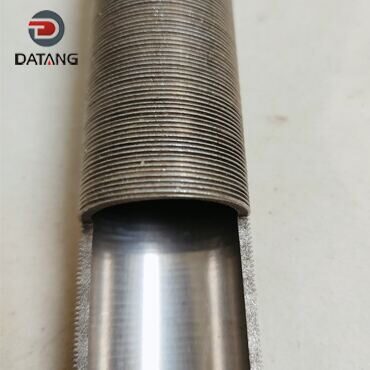
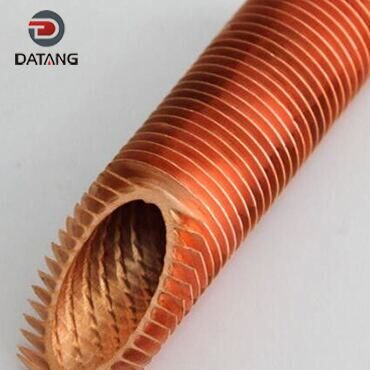
The fins are rolled out of the tube wall itself, so fin, tube and surface are one continuous piece of metal — no contact resistance, no bi-metallic joint, and no possibility of the fin coming loose.
How integral fins are made
The tube is passed through a rolling head that displaces the wall material outward into a helical fin while a mandrel controls the inside diameter. Because the fin is formed from the tube material, the wall under the fin thins predictably and the bore stays smooth. The result is a single-piece tube with excellent mechanical integrity.
Product Gallery
Typical specification
| Parameter | Range |
|---|---|
| Base tube OD | 9 mm – 51 mm |
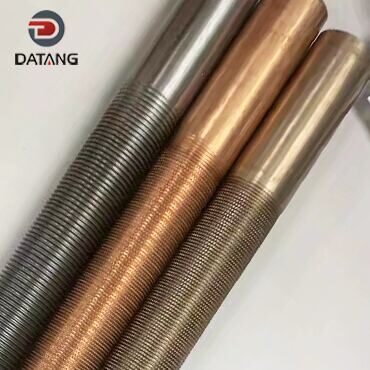
| Base tube material | Carbon steel, stainless steel, copper, copper-nickel, titanium |
| Fin height | 1.5 mm – 5 mm |
| Fin pitch | 1.5 mm – 3.5 mm |
| Fin thickness | 0.3 mm – 0.8 mm |
| Working temperature | Up to 400 °C (752 °F) |
Advantages
- Zero contact resistance — the fin and tube are the same material.
- No bi-metallic corrosion couple and no differential expansion between fin and tube.
- Compact, robust and easy to clean compared with welded fin tubes.
- Available internally finned as well, for tube-side enhancement in chillers and condensers.
Where it fits
Chiller and condenser retubes, compressor intercoolers and aftercoolers, marine heat exchangers, air-cooled condensers and compact HVAC coils. Integral low-fin tubes are often the best answer when the tube side is the controlling resistance.
Request integral fin tube data
Tell us the tube diameter, fin height, fin pitch, materials and quantity — we reply with price and lead time within one working day.