
Six fin types compared on surface area, heat transfer, pressure drop, temperature limit, weight and cost — using a common 25 mm base tube at 3.2 mm pitch.
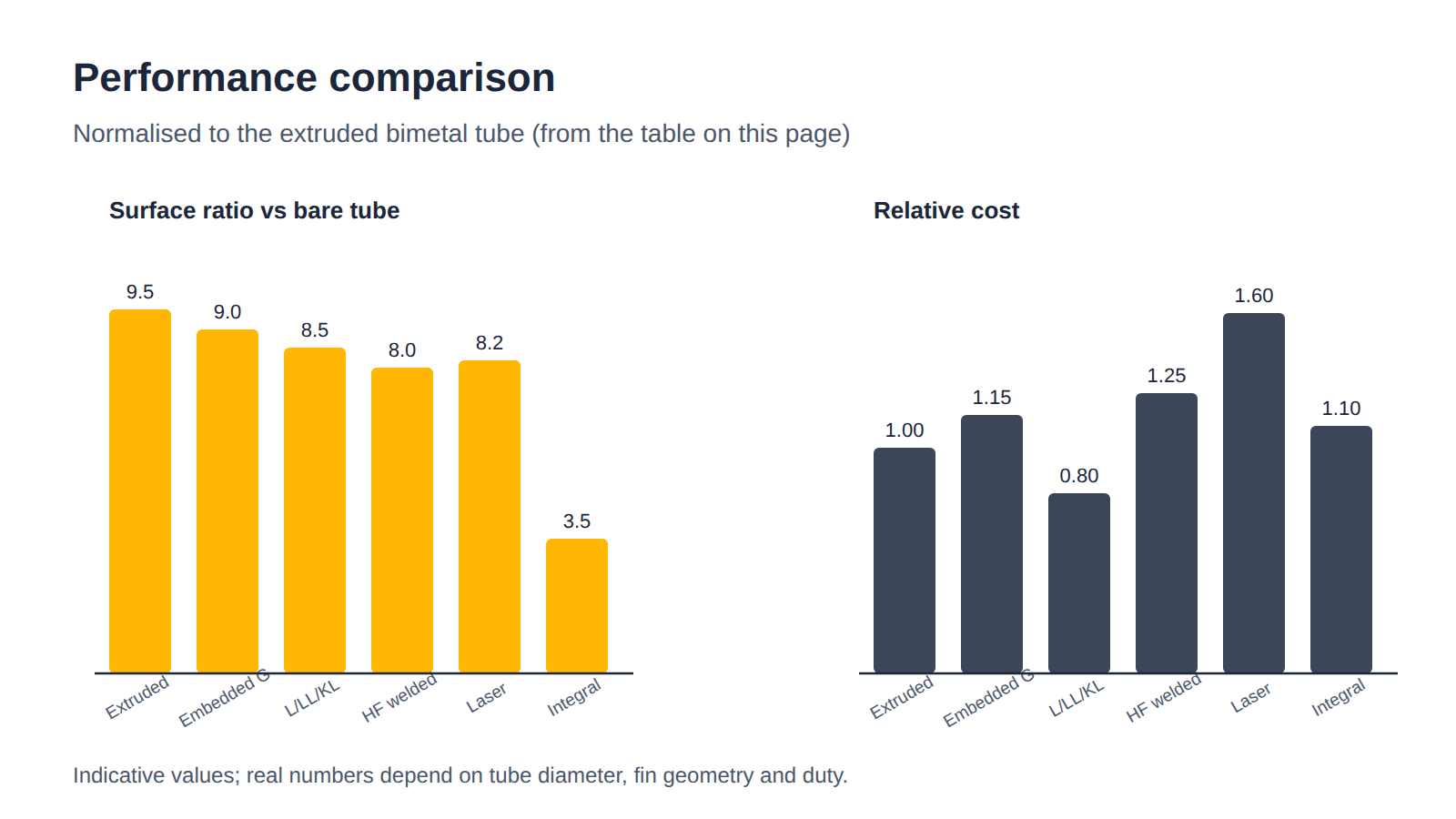
Normalised comparison
| Metric | Extruded | Embedded G | L/LL/KL | HF welded | Laser | Integral |
|---|---|---|---|---|---|---|
| Surface ratio (vs bare) | 9.5 | 9.0 | 8.5 | 8.0 | 8.2 | 3.5 |
| Relative U value | 1.00 | 0.97 | 0.88 | 1.05 | 1.05 | 0.75 |
| Pressure drop (relative) | 1.00 | 1.00 | 1.00 | 1.05 | 1.02 | 0.80 |
| Max metal temp. | 250 °C | 400 °C | 250–300 °C | 600 °C | 700 °C | 400 °C |
| Weight (relative) | 1.00 | 1.05 | 0.95 | 1.30 | 1.15 | 0.90 |
| Relative cost | 1.00 | 1.15 | 0.80 | 1.25 | 1.60 | 1.10 |
Values are indicative and normalised to the extruded bimetal tube; the real numbers depend on tube diameter, fin geometry and the duty. They are useful for understanding the trade-offs, not for final design.
Reading the numbers
- If the duty is clean and below 250 °C, extruded gives the best heat transfer per unit cost.
- If the duty is above 350 °C, welded or embedded constructions are the only stable options; cost per kW rises but life expectancy rises more.
- If space is tight and the tube side controls, integral fins win on compactness.
- If corrosion is the governing risk, the cheapest tube that survives is not always the lowest-cost option over the plant life.
Ask for a comparison on your duty
Tell us the tube diameter, fin height, fin pitch, materials and quantity — we reply with price and lead time within one working day.